
Exposed beams are a defining feature of many Arizona homes. From decorative vigas and patio beams to rafter tails, parapet extensions, and exterior wood accents, these details give a home warmth, depth, and Southwestern character. But because these beams are exposed to Arizona sun, heat, wind, and monsoon moisture, the ends can crack, split, rot, and deteriorate over time.
When homeowners see damaged beam ends, they often assume the entire beam needs to be removed and replaced. In some cases, replacement is the right answer. But many deteriorated exposed beam ends can be repaired, rebuilt, reshaped, and protected without replacing the full beam.
At Sticks’n Steel Construction, we help homeowners determine whether beam end repair, exposed beam restoration, epoxy rebuilding, or full beam replacement is the best solution. The right approach depends on the condition of the wood, the depth of the damage, and whether the beam is decorative or structural.
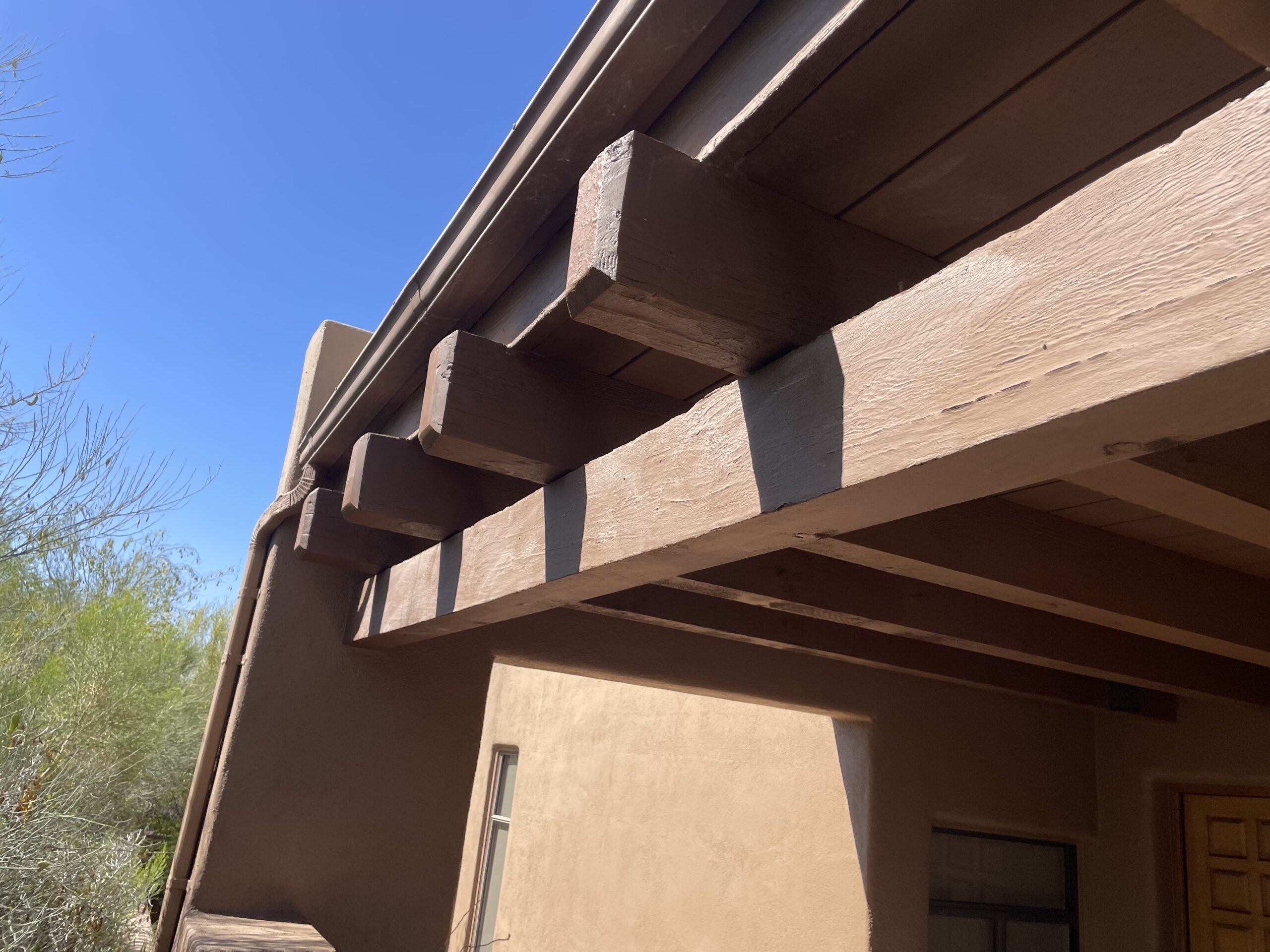
Weathered exposed beam end showing cracking and deterioration before restoration.
Table of Contents
- Why Exposed Beam Ends Deteriorate in Arizona
- When Rotted Beam Ends Can Often Be Repaired
- What Beam End Restoration Involves
- When Full Beam Replacement May Be Necessary
- Beam Repair vs Beam Replacement
- Why Repair Can Be a Smart Option for Arizona Homes
- How Protective Beam Caps Help
- Signs Your Exposed Beam Ends Need Repair
- Avoid Temporary Patch Jobs
- Choosing the Right Contractor for Beam End Repair
- Frequently Asked Questions
Why Exposed Beam Ends Deteriorate in Arizona
Arizona’s climate is tough on exterior wood. Constant UV exposure can dry out exposed beam ends, causing checking, splitting, fading, and surface breakdown. During monsoon season, rain can enter those cracks and accelerate deterioration. Over time, the beam end may begin to soften, lose material, or develop visible dry rot.
Beam ends are especially vulnerable because they are often the most exposed part of the wood. When the end grain is left unprotected or the finish begins to fail, moisture and sun damage can work their way into the beam faster than many homeowners expect.
Common causes of exposed beam deterioration include:
- Long-term UV exposure
- Dry heat causing cracks and splits
- Monsoon rain entering open cracks
- Aging paint, stain, or sealant
- Unprotected beam ends
- Poor previous patch repairs
- Moisture trapped under failing coatings
- Natural weathering of exterior wood
When Rotted Beam Ends Can Often Be Repaired
Beam end repair may be the right option when the damage is concentrated at the exposed end and the remaining beam is still stable. If the deterioration has not spread deep into the wood or compromised the beam’s function, restoration can often rebuild the damaged area while preserving the original beam.
Repair is often worth considering when:
- The damage is limited to the exposed end of the beam
- The main portion of the beam is still solid
- The beam is decorative or partially decorative
- The homeowner wants to preserve the home’s original architecture
- Full replacement would be disruptive or unnecessary
- The missing or deteriorated section can be rebuilt and reshaped
- A protective cap can be added after restoration
Many damaged beam ends look worse than they actually are. Missing chunks, surface rot, cracking, or weathered edges do not always mean the entire beam has failed. A proper inspection can determine whether the beam is a candidate for restoration.
What Beam End Restoration Involves
Professional beam end restoration is more than a surface patch. The goal is to remove failing material, stabilize the remaining wood, rebuild the missing section, and finish the beam so it looks intentional and holds up better against future exposure.
A typical beam end restoration process may include:
- Inspection: The damaged beam end is evaluated to determine how far the deterioration extends.
- Removal of damaged material: Loose, rotted, cracked, or unstable wood is removed.
- Wood stabilization: The remaining beam end is prepared so the repair can bond properly.
- Epoxy rebuilding: Missing or deteriorated sections are rebuilt using a professional restoration system.
- Shaping and sanding: The repaired beam end is shaped to match the original profile as closely as possible.
- Finishing: The beam is painted, stained, or sealed depending on the project.
- Protective caps: When appropriate, a metal cap can be installed to help protect the repaired beam end from future sun and moisture exposure.
When Full Beam Replacement May Be Necessary
There are times when repair is not the best choice. If the damage extends too far into the beam, affects structural performance, or leaves the wood unstable, full replacement may be necessary.
Replacement may be recommended when:
- The beam is structurally compromised
- Rot extends far beyond the exposed end
- The beam has severe internal decay
- The wood is soft or failing through a large section
- The beam supports a load and cannot be safely restored
- Previous repairs have failed extensively
- There is widespread deterioration across multiple areas
In those cases, patching the visible damage may only hide a bigger problem. A good contractor should be able to explain whether restoration is realistic or whether replacement is the safer long-term choice.
Beam Repair vs Beam Replacement
The difference between repair and replacement comes down to how much of the beam is damaged and what role the beam plays in the home.
Beam End Repair
Beam end repair focuses on restoring the deteriorated portion of the exposed beam. It is usually less invasive than full replacement and can be a smart option when the damage is isolated to the end. This approach helps preserve the existing beam, maintain the home’s original look, and reduce unnecessary demolition.
Full Beam Replacement
Full beam replacement involves removing the damaged beam and installing a new one. This may be necessary when the beam is too deteriorated to restore or when the damage affects structural integrity. Replacement can be more involved because it may require removing surrounding materials, matching finishes, and addressing any related construction details.
Why Repair Can Be a Smart Option for Arizona Homes
Many exposed beams on Arizona homes are architectural features. They help define the look of Southwestern, Santa Fe, territorial, and desert-style homes. When these beams deteriorate, replacing them can be more complicated than homeowners expect.
Beam end repair can help:
- Preserve the original architectural character of the home
- Reduce disruption compared to full replacement
- Restore missing or damaged beam ends
- Improve curb appeal
- Protect exposed wood from future weather damage
- Allow for protective metal caps after restoration
- Address the visible damage without unnecessary removal
For many homeowners, the biggest benefit is learning that the beam may be salvageable. A deteriorated end does not always mean the entire beam has to come out.
How Protective Beam Caps Help
After a beam end has been repaired, protective metal caps can help reduce future exposure. These caps are installed over the exposed ends to help shield the repaired wood from direct sun, rain, and long-term weathering.
Beam caps can be especially useful in Arizona because the beam end is often the area most exposed to UV and moisture. While no exterior wood feature is maintenance-free, a repaired and protected beam end can look better and last longer than one left exposed and deteriorating.
Signs Your Exposed Beam Ends Need Repair
Homeowners should inspect exposed beam ends regularly, especially before and after monsoon season. Early repair can often prevent a small issue from becoming a larger project.
Signs that your beam ends may need attention include:
- Cracking or splitting at the beam end
- Soft or crumbly wood
- Missing chunks of wood
- Peeling paint or failing stain
- Dark staining around cracks
- Visible dry rot
- Uneven or deteriorated beam profiles
- Previous patchwork pulling away
- Water damage after storms
Avoid Temporary Patch Jobs
Temporary patching may make a damaged beam look better for a short time, but it often fails if the underlying deterioration is not addressed. Covering rotted or unstable wood can trap moisture and allow the damage to continue beneath the surface.
A proper repair starts with preparation. Damaged material should be removed, the remaining wood should be stable, and the rebuilt section should be shaped and finished correctly. For exposed beam ends, the long-term success of the repair depends on what happens before the final finish is applied.
Choosing the Right Contractor for Beam End Repair
Beam end restoration requires more than basic patchwork. The contractor should understand how to evaluate damaged exterior wood, determine whether restoration is appropriate, rebuild missing sections, and protect the finished beam from future exposure.
Before starting the project, homeowners should understand:
- Whether the beam is a good candidate for repair
- How much damaged material needs to be removed
- Whether epoxy restoration is appropriate
- Whether a protective cap system makes sense
- How the repair will be shaped and finished
- When replacement would be a better option
Sticks’n Steel Construction provides beam end repair and exposed beam restoration for homeowners throughout the Phoenix area. Our team can evaluate the damage and explain whether repair or replacement makes the most sense.
So, Should You Repair or Replace Rotted Exposed Beams?
If the damage is limited to the exposed beam end and the remaining wood is stable, repair may be a practical and effective solution. If the deterioration extends deeper into the beam or affects structural integrity, replacement may be necessary.
The best first step is an honest evaluation. A qualified contractor can inspect the beam, explain the condition of the wood, and recommend the most appropriate repair method.
For many Arizona homeowners, beam end restoration offers a way to preserve the home’s original character while addressing visible damage caused by sun, heat, and weather exposure.
Frequently Asked Questions About Rotted Exposed Beams
Can rotted exposed beam ends be repaired?
Yes, many rotted exposed beam ends can be repaired if the damage is limited to the exposed end and the remaining wood is stable. If the deterioration extends deep into the beam or affects structural integrity, full replacement may be necessary.
Is beam end repair better than full beam replacement?
Beam end repair can be a better option when the damage is isolated and the original beam can be preserved. Full replacement may be better when the beam is structurally compromised, severely deteriorated, or no longer safe to restore.
Why do exposed beam ends rot in Arizona?
Arizona sun, UV exposure, dry heat, and monsoon moisture can cause exposed beam ends to crack, split, and deteriorate over time. Once cracks open up, moisture can enter the wood and accelerate dry rot or surface breakdown.
What is epoxy beam restoration?
Epoxy beam restoration is a repair process where damaged or missing sections of the beam end are cleaned out, stabilized, rebuilt, shaped, sanded, and finished. It is often used when the beam end can be restored instead of fully replaced.
Do protective beam caps help prevent future damage?
Yes. Protective metal beam caps can help shield exposed beam ends from direct sun and rain. They are often recommended after restoration to help reduce future UV and moisture exposure.
Do you repair vigas and decorative exterior beams?
Yes. Sticks’n Steel Construction repairs exposed vigas, decorative beam ends, patio beams, parapet beam extensions, rafter tails, and other exterior wood features commonly found on Arizona homes.
Schedule Beam End Repair in Phoenix, AZ
If your exposed beam ends are cracked, rotted, split, weathered, or missing sections, Sticks’n Steel Construction can help. We provide beam end repair, exposed beam restoration, viga repair, dry rot beam repair, epoxy rebuilding, and protective beam cap solutions for homes throughout the Phoenix area.
Contact Sticks’n Steel Construction today to schedule a beam repair consultation and find out whether your damaged exposed beams can be restored.